Page 1 of 2
Mapping Hex 1907
Posted: Sat Aug 25, 2012 1:30 pm
by Jeffr0
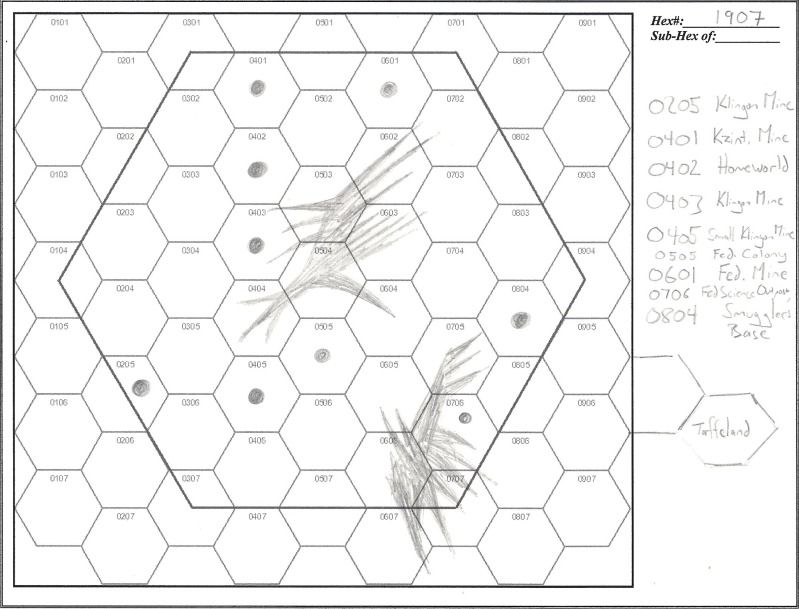
This is a "points of interest" map and as such it is far from complete. There could easily be a dozen neutral worlds that are relatively insignificant... not to mention worlds that are interesting but that are practically unknown and/or a few unusual stellar phenomena. So... this map just covers the high spots.
One hex is 83 and 1/3 parsecs across... and takes four and a half days to cross at Warp 7.
Posted: Sat Aug 25, 2012 10:39 pm
by Jeffr0
More notes:
1907-(0601) -- This was a Kzinti mine that went bust and was sold to the Federation. This is Skexis' birth world.
1907's Central nebula -- Captain Jack saw some freaky stuff here back when he was serving on the OCL USS Suffolk.
1907-(0706) -- The Federation science outpost is positioned to study and observe disturbances in the space-time continuum that purportedly occur here.
1907-(0804) -- Not even Captain Jack knew about this particular smuggler's base.
Posted: Tue Aug 28, 2012 4:40 pm
by Jeffr0
These nebula are unusually large-- maybe even the largest observed in known space.
Posted: Fri Oct 05, 2012 2:48 pm
by Jeffr0
The Federation colony in hex 1907, subhex 0505 is Otrai.
Posted: Fri Oct 05, 2012 3:07 pm
by Jeffr0
This is from a while back, but if you're going to adventure in this hex... we can presume that Captain Jack has talked about this when he was sufficiently liquored up:
Captain Jack wrote:Captain Jack was a senior LT. on a star fleet light cruiser [GM: it was the USS Suffolk] a while back. a shipping convoy passed through hex 1907 and sent out a garbled distress signal. Star Fleet ordered the cruiser to investigate, and all we found was wreckage. as we passed the anomaly, we experienced navigational difficulties like nothing Star Fleet has recorded before. We didn't find any survivors, and experienced random system failures. it ended up being captain jack and the second officer using visual star navigation before we could exit the anomaly. Star Fleet ordered the cruiser into that anomaly 3 other times, each time, failures got worse, more people got hurt or killed and it was mostly luck that jack and the second officer could navigate them safely out of that using primitive sublight visual star navigation. There was no conclusion about what this anomaly was, aside from being "large." This wasn't the incident that got Captain Jack out of Star Fleet, but he's nervous about that area because he lost some good friends, and felt the manner in which they investigated was foolish and wasteful. Star Fleet has a beacon to warn others, however, we both know that the Orions routinely steal those and put them elsewhere near by to help to obscure secret bases and meeting places.
(This report is about the large central nebula of hex 1907, not the smaller one that straddles the hex-side.)
Posted: Fri Oct 05, 2012 8:05 pm
by Jeffr0
This is from Steve Cole: "Every F&E hex includes at least 50 inhabited planets (ranging from a few dozen colonists up) and at least one each of every kind of astronominal/geographical phenomenon you can pick."
So that means... that the worlds referenced above are not the only inhabited planets. They are just eight "points of interest." Inhabited worlds that aren't listed are usually outposts of various sorts... or else non-space faring species' home worlds... or else other small and/or insignificant worlds.
Posted: Wed Oct 31, 2012 5:22 pm
by Sgt_G
Each F&E hex 500 parsecs across and thick. That's 125,000,000 cubic parsecs. Let's assume for simple-math's sake that there's an average of one stellar body every five parsecs, or one such per 125 cubic parsecs. That means there are roughly one million stellar bodies per F&E hex.
If one were to further assume that 10% of these are stars with planetary systems, and then 1% of those have planets worth visiting. That's about a thousand planets that one could "safely" put a mining base or military outpost on. Let's further estimate that 1% of these planets are Class-M and can support life without too much terraforming required. Therefore, by this math, there are approximately ten potential colony worlds in each F&E hex. In SVC's opinion, it's more like 50 terra-colony worlds and 200 domed-colony worlds.
Of course, few of these would actually have been discovered, let alone of any colonies built yet. I mean, how long would it take to survey a million stars?
Posted: Thu Nov 01, 2012 4:46 pm
by gurps_gm
Jeffr0, what product are you using for your hex grid?
Posted: Thu Nov 01, 2012 5:58 pm
by Jeffr0
gurps_gm wrote:Jeffr0, what product are you using for your hex grid?
gurps_gm, the "infinite zoom" hex maps I use are from
here.
Posted: Fri Nov 02, 2012 7:26 pm
by gurps_gm
Thanks! This is what I've been looking for.

Posted: Wed Nov 21, 2012 2:33 pm
by SYKOJAK
Yeah, that is the beauty about using the GURPS system. They do love thier
Hexes within Hexes system. It is cool at times and a pain at other times.
Posted: Wed Nov 21, 2012 2:44 pm
by Jeffr0
SYKOJAK wrote:Yeah, that is the beauty about using the GURPS system. They do love thier
Hexes within Hexes system. It is cool at times and a pain at other times.
I have not observed it directly in GURPSdom. The technique is lifted from the Old School Revival Hex Crawl Sandbox 0e 1e B/X Dungeons & Dragons people.
Posted: Fri Nov 23, 2012 12:23 am
by aramis
Jeffr0 wrote:SYKOJAK wrote:Yeah, that is the beauty about using the GURPS system. They do love thier
Hexes within Hexes system. It is cool at times and a pain at other times.
I have not observed it directly in GURPSdom. The technique is lifted from the Old School Revival Hex Crawl Sandbox 0e 1e B/X Dungeons & Dragons people.
First place I ever encountered it was in SJ's The Fantasy Trip - specifically the module "In Tolenkar's Lair"...
Posted: Wed Dec 24, 2014 6:10 am
by Sgt_G
Just playing around with my CAD, I came up with this nested hex-grid:

There are 16 sub-hexes within each hex (13 full ones plus 6 half-hexes), with 16 sub-sub-hexes nested within the sub-hexes, for 256 per hex.
From side-to-side, the sub-hexes are 125 parsecs, and 31.25 parsecs per sub-sub-hex.
Opinions?
Posted: Wed Dec 24, 2014 8:19 pm
by Mike
21 sub-hexes across from vertex point to vertex point.
16 sub-hexes flat side to opposite flat side.